Markets and investing
When Capital Is No Longer the Constraint
 Rosario Diaz Ausa
6 October 2026 · 7 min read

There is a point in the development of a market when the nature of the investment question begins to change. In the early stages, the concern is whether capital can be attracted at all: whether investors will believe in the opportunity, whether the institutional environment is sufficiently credible, and whether there is enough visibility into the future to justify making the first allocation. As the market develops, the question becomes one of scale: how much capital can be deployed, into which sectors, and at what pace. But once the pipeline becomes large enough, another constraint begins to matter, and it is one that is much harder to see from a distance: whether the market has the capacity to turn all of that capital into something real.
This, increasingly, feels like the more interesting question for Abu Dhabi.
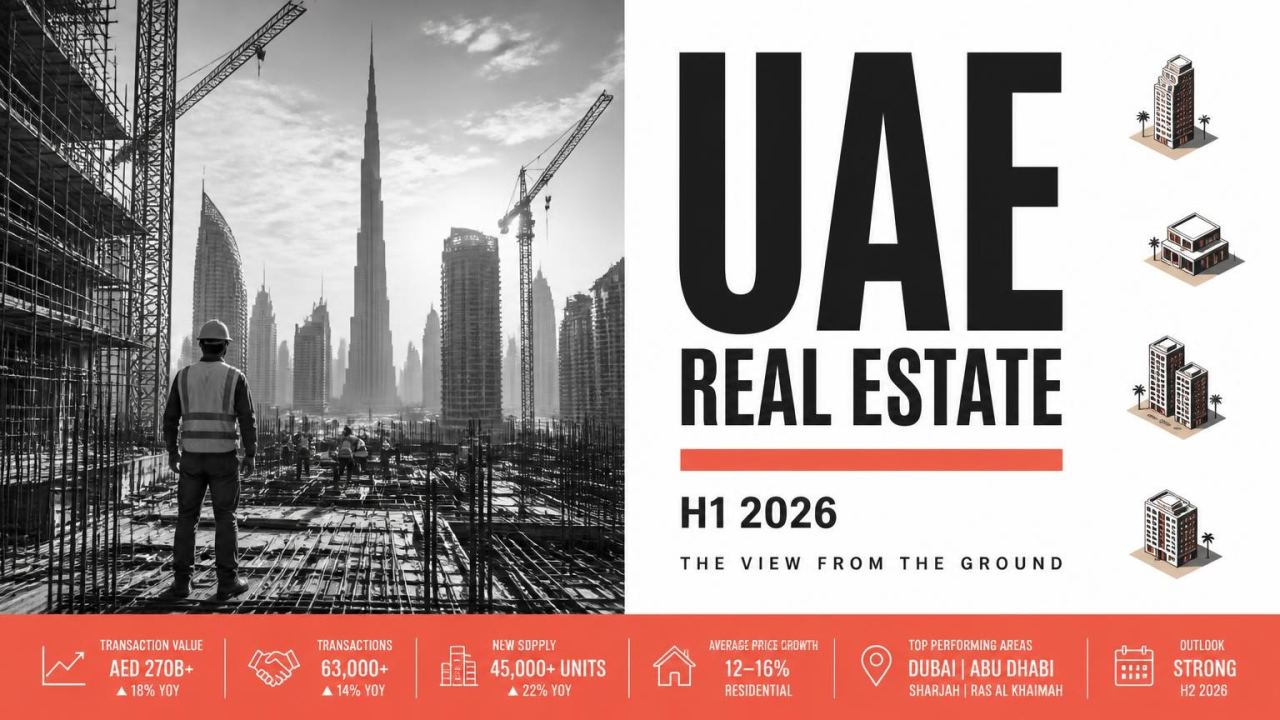
The scale of the opportunity is no longer difficult to demonstrate. Real estate transactions reached AED117 billion in the first half of 2026, more than twice the value recorded during the same period last year, while residential transactions alone accounted for AED70.4 billion. Yet perhaps the more revealing figure is that 89% of residential sales value came from off plan transactions, with approximately 71,000 additional residential units expected to be delivered across the emirate by 2030. The numbers describe a market in which a significant amount of the investment proposition is still being translated from expectation into physical reality.
That translation is where execution becomes important.
It is tempting, when looking at a market experiencing this degree of growth, to think of capital as the scarce resource. In reality, capital can move much faster than the things it is trying to build. A development pipeline ultimately depends on engineers, contractors, skilled labour, materials, logistics, infrastructure, permitting and the countless businesses that sit beneath the headline developer. If the same contractors, the same supply chains and the same pools of skilled people are suddenly required to deliver several times what they were previously delivering, the consequences do not necessarily appear in the investment thesis at the moment the capital is committed. They appear later, in construction costs, delivery schedules, margins and ultimately in the returns generated by the asset.
This is why execution should be understood not as an operational consideration sitting somewhere below investment strategy, but as part of the investment thesis itself. The question is not merely whether a project is economically attractive or whether the developer has sufficient capital behind it. It is whether the ecosystem around that project has the capacity to deliver it alongside everything else that is being built at the same time. A market can have an extraordinary amount of capital available to it and still find that the limiting factor is the ability to deploy that capital efficiently.
There is a broader implication here for institutional investors. As markets become more sophisticated, due diligence inevitably moves beyond the asset itself and towards the conditions that make the asset possible. The quality of a development proposition cannot be separated entirely from the quality of the ecosystem that will deliver it, just as the return on a portfolio cannot be understood simply by looking at the assets within it without considering the correlations that connect them.
This is particularly relevant in a market where so many of the most compelling opportunities are still associated with growth that has not yet been fully tested. There is an important difference between an asset whose economics have already been demonstrated through delivery and operation, and one whose attractiveness still depends on a series of assumptions about future demand, construction, infrastructure and pricing. The latter may ultimately generate greater returns, but it also contains more variables that have not yet had the opportunity to prove themselves. For an institutional investor, the question is therefore not simply where the growth is, but how much of that growth has already become observable.
The same distinction applies to diversification. It is possible to own a property, an interest in a local lender and an allocation to a private credit vehicle and feel that a portfolio has been spread across several asset classes, while still being exposed to essentially the same underlying cycle. If all three ultimately depend on the same property values, the same liquidity conditions, the same government spending or the same construction ecosystem, then the diversification is more apparent than real. What matters is not the number of investments on the balance sheet, but the number of genuinely independent sources of risk and return.
That becomes increasingly important as Abu Dhabi expands into new sectors and clusters. The opportunity is not simply that there are more things in which to invest; it is that investors now have to become more discerning about where each opportunity sits within its own lifecycle. Some sectors have already produced functioning assets and therefore provide evidence about how the market behaves. Others remain closer to the beginning of their development curve, where the potential is considerable but the assumptions are less tested. A sophisticated portfolio should be able to accommodate both without confusing novelty with diversification or maturity with lack of opportunity.
And this is where transparency enters the discussion in a way that goes considerably beyond the familiar argument that institutional investors simply need more data.
Transparency matters because it allows an investor to understand the distance between what has been announced and what is actually happening. It makes it possible to observe how capital is being deployed, whether cash flows are behaving as expected, whether assets are performing, how regulations are evolving and whether the assumptions that supported an investment decision remain intact. In a market moving as quickly as Abu Dhabi is today, that visibility becomes particularly valuable because the investment thesis itself is not static. It is being tested continuously as projects are delivered, sectors mature and capital moves through the economy.
There is also a less obvious value to transparency. It can change the way investors behave when something goes wrong.
No market, however well governed, is insulated from geopolitical shocks, changes in the global economy or periods in which the assumptions underpinning an investment suddenly become less certain. The institutional question is therefore not whether uncertainty can be eliminated, but whether investors have enough visibility into the response to uncertainty to make a rational decision about what comes next. Transparency shortens that distance. It does not make the event less significant, but it allows investors to understand the response, reassess the risk and decide whether the original thesis still holds.
This is why transparency and predictability, although often spoken about together, are not quite the same thing. Transparency is about what an investor can see; predictability is about what that investor can reasonably expect to happen next. For capital being committed over ten or fifteen years, that distinction is fundamental. No investor can know what the economic environment will look like a decade from now, but they can observe how a market behaves when conditions change, whether institutions consistently follow through on stated plans, whether regulations evolve with clarity, and whether capital can ultimately move in and out of the market in accordance with the assumptions on which it was committed.
Over time, those behaviours become part of the investment proposition.
This is also what makes patient capital different from simply holding an asset for a long period. Patience requires the capacity to remain engaged through different points in the cycle without being forced into a decision by short term pressure, but it also requires enough understanding of the market to distinguish between volatility that is part of a normal cycle and a change that represents something more fundamental. A patient investor is therefore not necessarily a passive one. In some circumstances, patience means holding; in others, it means reducing exposure; and in still others, it means having the liquidity and conviction to increase exposure precisely when the market has become less comfortable.
That kind of behaviour is difficult without transparency, but it is almost impossible without some degree of predictability.
Perhaps this is why the next phase of Abu Dhabi's development feels different from the one that came before it. The question is increasingly less about whether the emirate can convince investors that there is an opportunity here. The opportunity is visible. The more consequential question is whether the market can continue to scale without allowing the success of the pipeline itself to become a constraint, whether it can build the physical and human capacity required to deliver, maintain the transparency required for investors to understand what is happening, and preserve the consistency that allows long duration capital to remain confident through inevitable periods of uncertainty.
There is a certain irony in this. The characteristics that made the market attractive in the first place, including speed, ambition, capital availability and the willingness to build for the future, eventually create a different set of institutional demands. Growth creates complexity, and complexity requires more visibility, more capacity and, ultimately, more predictability.
The measure of the next stage of Abu Dhabi's development may therefore not be how much capital it can attract, but how effectively it can convert that capital into enduring economic value.
Because for institutional investors, the credibility of a market is ultimately found in the distance between what it says will happen and what actually happens over time.
And that distance is where execution, transparency and predictability become more than characteristics of a market.
They become part of the investment case itself.
First published on LinkedIn.