Markets and investing
The New European Prime: Why UHNW Capital Is Quietly Repositioning Across Southern Europe
 Rosario Diaz Ausa
25 May 2026 · 15 min read
The question has changed.
For most of the last decade, the conversation about European luxury real estate was framed around a familiar shortlist. London. Geneva. Paris. Zurich. The assumption was that density equalled prestige, that proximity to financial infrastructure was the natural home of serious capital, and that anything further south or off the primary city axis was a lifestyle indulgence rather than a legitimate allocation.
That assumption is now structurally outdated.
What is unfolding across Europe is not a wave of wealthy buyers chasing views and sunshine. It is a quiet but deliberate repositioning of capital by family offices, UHNW individuals, and globally mobile principals who are consolidating lifestyle, tax efficiency, and long-term capital preservation into a single real estate decision.
The geography of that decision now spans six distinct markets: Spain, Italy, Greece, Monaco, Switzerland, and the United Kingdom. Each operates under a different logic. Each attracts a specific buyer profile. And yet the same fundamental thesis connects all of them.
Understanding why requires moving beyond the lifestyle narrative entirely.
The Thesis: One Decision, Multiple Functions
Historically, a property decision served one primary purpose. A home was a home. An investment was an investment. Tax strategy was handled separately, by advisors in different jurisdictions who rarely spoke to one another.
Today's UHNW buyer increasingly refuses that segmentation.
The most sophisticated allocation in 2026 is one that simultaneously satisfies residency optionality, capital preservation in a hard asset, meaningful appreciation or yield potential, and a quality of life that anchors the family across generations. When a single asset can deliver all four functions, the economics of maintaining separate solutions in separate jurisdictions begin to collapse.
Europe has become the geography where that convergence is most legible to internationally mobile capital. Its legal systems are established. Its property rights are clear. Its cities and coastlines carry cultural depth that newer markets cannot manufacture. And its fiscal environments, across several jurisdictions, have become actively competitive in attracting incoming wealth.
What follows is not a survey of European real estate markets. It is an attempt to articulate why six specific geographies are drawing serious capital right now, and what the connective logic is between them.
Spain: Supply Compression and the Permanence of Demand
Southern Spain is experiencing something more significant than a property cycle. It is experiencing a structural rerating.
For years, Marbella was understood primarily as a seasonal market. Wealthy Europeans arrived in summer, occupied their second homes, and returned north in autumn. The market served that pattern efficiently but without particular depth.
What has changed is the permanence of the inbound flow.
The buyer profile has shifted decisively toward lifestyle migration rather than lifestyle tourism. Entrepreneurs relocating with their families. Remote principals who no longer need a fixed office address in Frankfurt or Stockholm. Gulf-based wealth seeking a western foothold with direct flight connectivity and cultural familiarity. Latin American capital choosing Spain for linguistic and cultural proximity as much as for fiscal reasons.
Marbella, Sotogrande, and La Zagaleta are absorbing this shift against a backdrop of structurally limited supply. Prime inventory in gated communities, beachfront positions, and low-density hillside estates does not replenish at the pace that demand has accelerated. The land is finite. Planning approvals in coveted municipalities are constrained. And the buyers entering the market today are not patient buyers. They are principals accustomed to moving quickly when conviction is established.
The result is a supply compression that pushes serious transactions further off-market. The best assets in La Zagaleta, the upper Golden Mile, and Sotogrande's polo and golf estates increasingly transact before they reach any visible listing platform. Access has become the differentiator.
For capital, this compression is not a problem. It is a signal. Scarcity in prime real estate, when it is structural rather than manufactured, is a return driver. Spain's exit universe spans buyers from thirty or more nationalities, covering Gulf, European, American, and Latin American capital, and that depth gives medium-term liquidity a credible foundation.
Italy: Irreplaceable Assets and a Tax Regime That Rewrites the Arithmetic
Italy's luxury real estate market operates under a different logic from Spain's, but arrives at a similar conclusion: the best assets are genuinely irreplaceable, the buyer universe is broadening, and the fiscal environment has become a material accelerator of demand.
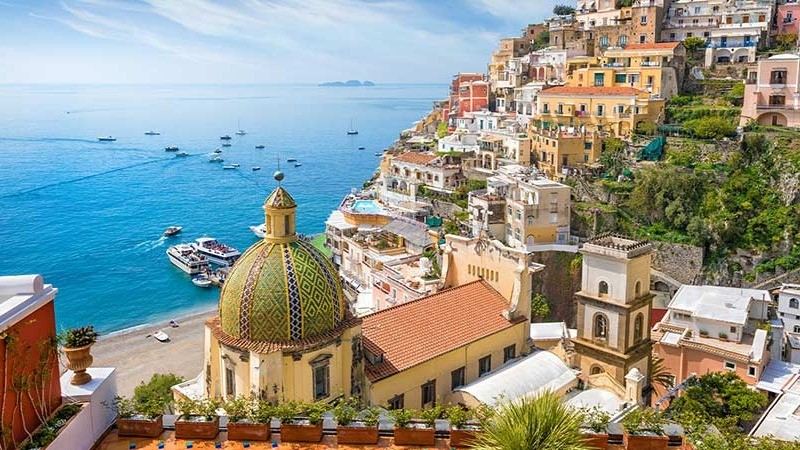
The irreplaceability argument is almost self-evident. A villa on the Amalfi Coast is not a product category from which more supply can be commissioned. A historic estate in the Tuscan hills, with provenance, original architecture, and agricultural land attached, is not something a developer can manufacture. A palazzo on Lake Como with private lakefront access exists in finite number, and fewer still come to market in any given decade.
This scarcity is not manufactured. It is built into the geography, into the heritage classification system, and into the nature of landed wealth in Italy, which has historically passed within families across generations rather than cycling through the open market.
When assets of this character do appear, they attract buyers who are not comparing them with alternatives in the same region. They are comparing them with generational assets globally, and pricing accordingly.
What has accelerated Italian demand is the country's non-domicile tax regime, which offers incoming residents a flat annual tax of €100,000 on all foreign-sourced income, regardless of the amount. For principals with significant international income streams, this is not a marginal incentive. It is a structural change in the arithmetic of where to base oneself.
The reform of the UK's non-dom regime, which provided a similar attraction for decades, has redirected a meaningful portion of internationally mobile wealth toward Italy as an alternative. The results are visible in the buyer profiles now appearing at the top of the Italian market: British principals, American fund managers, Gulf family office representatives, and northern European entrepreneurs for whom the combination of cultural depth, lifestyle quality, and favourable taxation resolves a decision that was previously more complicated.
The practical implication for real estate is that demand at the top of the Italian market has expanded its international base precisely as supply of genuine prime assets remains fixed. That is not a speculative dynamic. It is a structural one.
Greece: The Reemergence of a Market That Quietly Did the Work
Greece occupies a different position in this conversation from Spain and Italy. It is not a market that requires reframing. It is a market that simply requires recognition.
For most of the last fifteen years, Greece was filtered through the lens of its sovereign debt crisis. International capital was cautious, domestic confidence was fragile, and the real estate market reflected both. Values at the prime end compressed significantly. Transaction volumes fell. The most compelling assets, including island estates, Athenian neoclassical buildings, and seafront villas on the Peloponnese and the Ionian coastline, sat undervalued relative to their intrinsic quality and global comparables.
That period is now clearly behind the Greek market. What has replaced it is something more durable than a cyclical recovery: a fundamental rerating driven by improving sovereign credibility, significant infrastructure investment, and a wave of international buyers who arrived early and established the price discovery that others are now following.
The Greek market's appeal to international capital today rests on several converging factors. Asset quality at the premium end is exceptional. The Cyclades, the Ionian Islands, the Athenian Riviera, and select mainland coastlines offer physical beauty and cultural resonance that are, by any honest assessment, world-class. Pricing, even after recent appreciation, remains meaningfully below equivalent quality assets in the Côte d'Azur, Amalfi, or the Spanish coast. And Greece's Golden Visa programme, even as its thresholds have been revised upward, continues to provide a pathway to European residency that attracts capital from outside the EU, particularly from the Middle East, Asia, and the Americas.
The hospitality investment story in Greece is equally compelling. International operators are expanding their presence. Ultra-luxury branded developments in the islands are absorbing demand from buyers who want managed assets with genuine lifestyle access. And the short-term rental yield layer created by villa assets has added an income dimension that did not exist in the same form a decade ago.
Greece is no longer an emerging opportunity in the way that phrase is sometimes used as a euphemism for risk. It is an established prime market that still carries the pricing characteristics of its earlier phase. That combination does not last indefinitely.
Monaco and the Riviera Corridor: The Physics of Constrained Space
Monaco is not a real estate market in the conventional sense. It is a city-state of approximately two square kilometres, with a resident population among the wealthiest per capita on earth, governed by a constitutional monarchy with a century-long track record of political stability and fiscal sovereignty.
Zero income tax. Zero capital gains tax. Zero inheritance tax between direct heirs. A security infrastructure that produces one of the lowest crime rates globally. And a physical territory that cannot expand.
In pure investment terms, Monaco real estate is priced as a scarce institutional asset. Prime square metre values rank among the highest anywhere in the world. Transactional volume is constrained by the size of the stock, not by the absence of buyers. When units come to market, they are absorbed at prices that reflect the uniqueness of what is being offered.
The Riviera corridor extending into France, covering Cap Ferrat, Beaulieu-sur-Mer, Villefranche, Cannes, and Cap d'Antibes, functions as a natural extension of the same demand ecosystem. Buyers who cannot access Monaco inventory, or who seek larger estates than Monaco's density allows, move along the coast with identical profiles and purchasing intent. The same principals. The same fiscal logic. Larger footprints.
What drives Monaco beyond the fiscal argument is wealth density itself. A concentration of principals, family office representatives, advisors, and counterparties within a geography navigable on foot creates a specific type of social and professional infrastructure. Proximity in Monaco is not incidental. It is a deliberate feature of why principals choose to be there, and why they stay.
The investment case rests on three pillars that show no meaningful signs of weakening: zero supply growth by geography, expanding international demand particularly from Gulf and Asian capital, and the continued fiscal and political stability that gives long-duration money confidence in the jurisdiction.
Switzerland: Stability as a Product, and the Architecture of Discretion
Switzerland's position in the European prime real estate conversation is distinct from every other market on this list. It does not compete on lifestyle in the conventional sense, though its lifestyle offering is exceptional. It does not compete on fiscal novelty, though its cantonal tax regimes remain structurally attractive. It competes, above all, on the one quality that the wealthiest capital values most when cycles turn: certainty.
Swiss real estate is among the most tightly regulated in the world. The Lex Koller legislation has historically restricted non-resident foreign ownership, limiting the acquisition of residential property by overseas buyers to designated tourist zones and specific cantonal quotas. Supply of available prime stock, particularly in Geneva, Zurich, Zug, and the resort markets of Verbier, Gstaad, and St Moritz, is structurally constrained by these regulations as much as by geography.
For capital that qualifies, through residency establishment, permit acquisition, or the designated tourist-zone pathways, Switzerland offers something that other markets cannot fully replicate. A legal and institutional environment with the deepest track record of stability in Europe. A currency that has historically strengthened in periods of global stress. A banking and legal infrastructure built around discretion and precision. And a physical environment, spanning the lakes, the mountains, and the proximity to Geneva's international institutions and Zurich's financial centre, that retains principals who could live anywhere.
The lump-sum taxation arrangement available in several cantons, which taxes residents on estimated living expenses rather than actual income or wealth, continues to attract internationally mobile principals for whom simplicity and predictability of fiscal treatment are as valuable as the rate itself.
Swiss prime real estate does not offer spectacular near-term returns. It is not designed to. It offers something more valuable to a certain profile of buyer: the reasonable expectation that what you own will still be there, unencumbered and sound, in thirty years. In a global environment of elevated geopolitical uncertainty, that proposition commands a premium that yield arithmetic alone cannot fully explain.
The United Kingdom: Reform, Resilience, and the Recalibration of Prime
The UK occupies a more complicated position in this conversation than the other five markets. London has been a global prime real estate destination for decades. A genuinely international city with deep liquidity, transparent legal title, a common law system trusted by buyers from every jurisdiction, and a cultural and professional infrastructure that few cities can match.
What has changed is the fiscal environment, and the significance of that change should not be underestimated.
The reform of the non-domicile tax regime, which historically allowed UK residents with overseas domicile status to shelter foreign income and gains from UK taxation, has altered the calculation for a meaningful cohort of internationally mobile buyers. Principals who structured their UK residency around non-dom status are reassessing. Some have relocated. Others are consolidating holdings rather than expanding them. The impact on the top end of the London market, the tier most populated by internationally mobile non-dom buyers, has been measurable.
And yet the narrative of London's decline as a prime market is, in our view, substantially overstated.
The fundamentals that made London a global capital anchor have not changed. Legal clarity. Deep institutional liquidity. The English language. World-class education from primary through postgraduate level. Cultural infrastructure across arts, finance, medicine, and law that remains genuinely world-class. Time zone positioning that allows principals to speak with both Asian and American counterparties within a single working day.
What the non-dom reform has done is not eliminate demand. It has recalibrated it. Buyers entering the London market today are doing so with eyes open to a different tax landscape, and are pricing that landscape into their decisions accordingly. For buyers who are not dependent on non-dom status, the market remains as compelling as it has been. For buyers who were dependent on it, the conversation has shifted toward structuring, toward which asset classes remain most efficient to hold, and toward whether London functions better as a second residence than as a primary one.
The country markets adjacent to London, including the Cotswolds, Surrey, Hampshire, and the Home Counties, are experiencing a separate dynamic. Domestic and European wealth that values English countryside living, proximity to London without daily immersion in it, and estate assets with genuine land and privacy continues to drive sustained demand in these markets regardless of the non-dom conversation.
The UK market in 2026 is not what it was in 2016. But it remains one of the deepest, most legible, and most resilient prime real estate markets in the world. The buyers who understand its current complexity are the ones finding the most interesting positions within it.
The Connective Tissue: One Buyer, Six Geographies
What makes this six-market framework coherent as a capital thesis is not simply that each geography offers compelling individual arguments. It is that the same buyer is increasingly present across all of them.
The profile is recognisable. A principal, or a family office acting on behalf of one, with primary economic activity outside Europe or across multiple European jurisdictions, seeking to consolidate real estate across a portfolio that is deliberately diversified by geography, currency, legal system, and use case.
This buyer may hold a villa in Marbella as a primary lifestyle and family base, a historic estate in Tuscany as a generational asset, a Monaco apartment as a tax residency anchor, a chalet interest in Verbier or Gstaad as a winter presence, and London real estate as institutional-grade liquidity and educational proximity for their children. A Greek island asset, increasingly, is where the summer comes together.
These are not competing purchases. They are complementary positions in a portfolio that treats real estate as a strategic layer of wealth architecture, not a collection of properties.
A buyer operating across this corridor does not want six separate local advisors managing six disconnected transactions. They want a single point of coordination, with the market knowledge, legal structuring fluency, jurisdictional relationships, and institutional access to move decisively when an asset appears, regardless of which market it sits in.
That capability remains genuinely rare. Most boutique agencies are geographically concentrated. Most institutional firms focus on primary city markets and minimum ticket sizes that exclude the most interesting opportunities. Most intermediary networks lack the depth to deliver off-market access consistently across multiple jurisdictions simultaneously.
The gap between what this buyer needs and what the advisory market currently provides is where the most consequential work in European prime real estate now sits.
What This Means for Capital Going into 2027
Across all six markets, several structural features are worth holding in view for anyone making or advising real estate decisions in the current environment.
Supply is not the primary risk in any of these markets. In prime Spain, historic Italian estates, Greek island assets, Monaco, Swiss resort markets, and the top tier of London, constraint sits firmly on the supply side. The question for serious buyers is access and timing, not whether the market can absorb new inventory, because it largely cannot create it.
The international buyer base continues to broaden and deepen. Gulf capital, which was already active in London, Monaco, and Marbella a decade ago, has deepened its engagement across all six geographies. American family offices, historically concentrated in London and occasionally Paris, are increasingly active in Italy, Greece, and Spain. Indian UHNW capital, accelerating globally, is beginning to appear in markets it did not previously reach at scale. Each new entrant to the buyer pool expands the exit universe for existing holders, which is the definition of improving liquidity.
Fiscal positioning is now a first-order consideration, not a second-order one. The reform of the UK non-dom regime, the continued attractiveness of Italy's flat tax, Spain's Beckham Law and its broader non-domicile framework, Monaco's fundamental fiscal architecture, and Switzerland's cantonal lump-sum arrangements are all active variables in relocation and acquisition decisions. Advisors who do not integrate fiscal structuring into the real estate conversation are working with a structurally incomplete picture.
Off-market access has become the primary product at the top of all six markets. The most compelling assets in each geography, the ones with genuine scarcity, genuine provenance, and genuine long-term value, rarely reach open listing platforms. They are offered through trusted advisory relationships before any formal marketing process begins. For principals who are serious about accessing the best inventory, the quality and depth of the advisory relationship is the primary determinant of what they see.
A Closing Observation
There is a version of this conversation that focuses on lifestyle. The Mediterranean light. The Alps in winter. The cultural depth of cities that have been building for two millennia. The food, the language, the pace.
That version is not wrong. It is simply incomplete.
The more durable argument for European prime real estate as a capital destination is structural. Fixed or declining supply at the top of each market. Deep and broadening international demand. Fiscal environments across multiple jurisdictions that reward incoming wealth. Legal systems and property rights with track records measured in centuries. And a quality of life that retains principals across generations, not merely across seasons.
When those factors align simultaneously, real estate stops being a lifestyle decision and starts being an allocation.
Across Spain, Italy, Greece, Monaco, Switzerland, and the United Kingdom, that alignment is not a future prospect. It is the current condition.
The capital that recognises it clearly, and has the access, the structuring capability, and the cross-market fluency to act on it, is not simply acquiring beautiful assets. It is positioning itself in markets where the gap between current pricing and long-term fundamental value still favours the patient, well-advised buyer.
That window is narrower than it was five years ago. It is still open. But it will not remain so indefinitely.
For acquisition mandates, off-market access, or cross-market advisory enquiries: rose@maison-71.com
First published on LinkedIn.