Markets and investing
UAE Real Estate, H1 2026: What Held, What Changed, What Comes Next
 Rosario Diaz Ausa
21 August 2026 · 9 min read
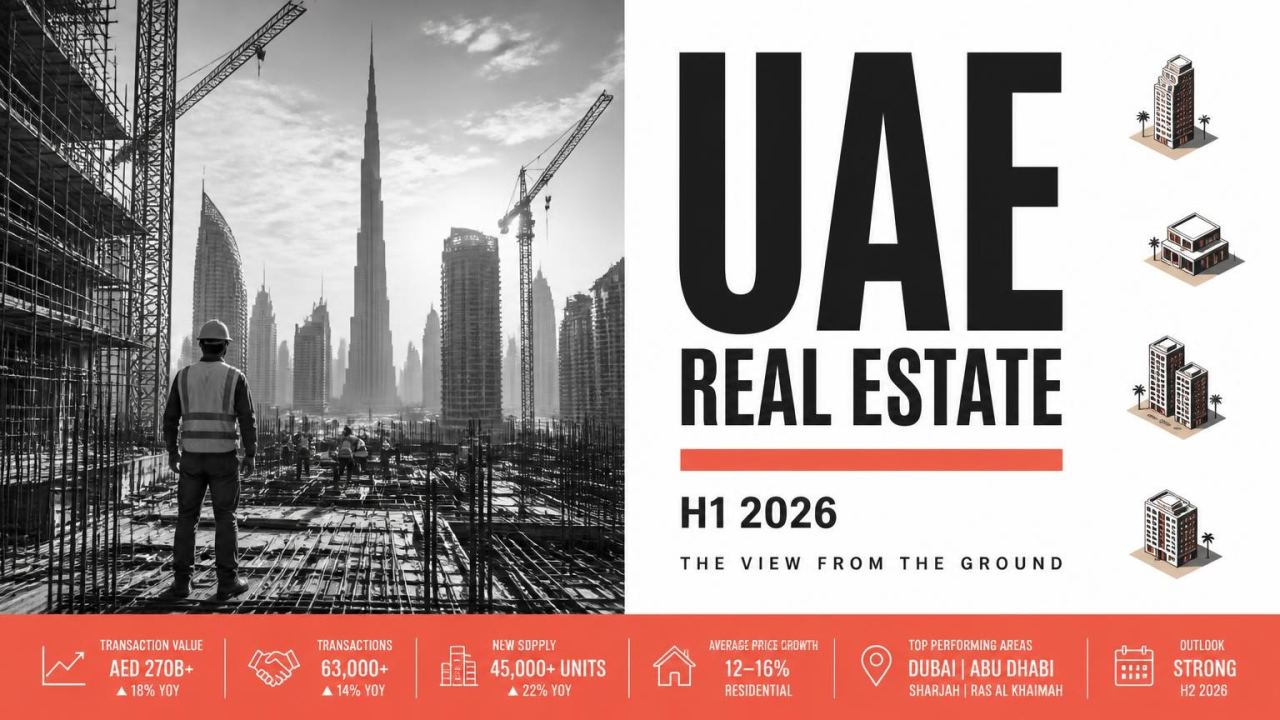
The View From the Ground
An insider's read on Abu Dhabi, Dubai and the wider emirates for investors in, and considering, the UAE market
H1 2026 gave the UAE real estate market its sharpest geopolitical stress test in years. Regional conflict disrupted trade, travel and private-sector confidence, buyers became more cautious, and transaction momentum softened into the second quarter. Abu Dhabi still closed the period with the strongest first half on record.
That is the headline that matters.
The moderation underneath it matters too, but for a different reason. It is showing us where demand is resilient, where buyers are becoming more selective, and where the market is beginning to distinguish between quality and momentum. The signal we take from H1 is not that the UAE is immune to what is happening around it. It is that Abu Dhabi's underlying demand still exceeds supply, foreign capital has continued to deepen, major developers are still building, and the market has absorbed a meaningful external shock without any material deterioration in its fundamentals.
We remain bullish. But H2 is not a market in which we would buy indiscriminately. This is why, and how we are positioning clients for what comes next.
Why We're Still Bullish
Colliers counted 22 new projects added to Abu Dhabi's development pipeline in Q1 alone, including nine branded residential schemes, despite regional conditions already beginning to weigh on sentiment. That does not mean every launch was a fresh vote on the geopolitical environment, development pipelines are built over years, but it does tell us something important about the depth of capital, planning, and execution already behind this cycle.
More importantly, the supply-demand equation remains supportive.
ADREC's H1 data puts total residential stock across the emirate at roughly 409,000 units, with approximately 71,000 additional homes projected by 2030. That is less than 20% incremental supply over the next four and a half years, against a population that grew by roughly 26% between 2020 and 2024 alone.
The regulator's own repeat-sales and repeat-lease indices, useful because they strip out much of the distortion caused by changes in product mix, rose 18% and 9% year-on-year respectively. ADREC's conclusion is explicit: demand exceeds supply in Abu Dhabi Region.
The rental market tells the same story from another angle. There are approximately 233,000 active residential lease contracts across the emirate, and close to seven in ten occupied homes in Abu Dhabi Region are rented rather than owned. That is a significant underlying pool of residents who already live in the market but have not yet moved into ownership. For us, that matters far more than launch-day absorption rates. It means demand is being fed from underneath by people whose lives are already here.
Where we differ from some of the more cautious readings of Q2 is not in whether the market slowed. It did. It is in what that slowdown means.
JLL describes the current environment as a recalibration, with cooling demand and incoming supply creating near-term pressure. ValuStrat similarly recorded Abu Dhabi's slowest quarterly rate of capital appreciation in two years. Both observations are important. But ValuStrat also found no material evidence of weakening demand, while prices continued to rise and ADREC's own data still showed demand outpacing supply.
That looks less like the end of the cycle to us than the beginning of a more selective phase of it.
Government intervention reinforces that view. Abu Dhabi froze rental increases from 2 June after a prolonged period of strong rental growth, and new-lease growth moderated almost immediately. Whatever one's view of the policy itself, the intervention demonstrates a regulator willing to act early when affordability begins to come under pressure rather than allowing an overheated rental market to run unchecked.
The macro picture is less comfortable than it was six months ago, but it also looks more like an interruption than a structural deterioration. The UAE Central Bank expects regional disruption to pull economic growth down to 1.7% in 2026 before rebounding sharply to 9.8% in 2027, supported by higher oil production, continued non-oil growth, government spending and infrastructure investment. Moody's has maintained the UAE's Aa2 sovereign rating with a stable outlook.
That is the context in which we are reading H2: more risk, more selectivity, but no fundamental reason yet to abandon the long-term thesis.
Abu Dhabi in Focus
Abu Dhabi recorded AED 117 billion in total real estate transactions during H1 2026, up 112% year-on-year and equivalent to more than four-fifths of the value transacted during the whole of 2025.
Residential unit sales reached AED 70.4 billion, nearly triple H1 2025. Foreign buyers (resident expatriates and non-resident investors combined) accounted for more than 70% of residential sales value. Non-resident FDI alone reached AED 13.8 billion, roughly four times the previous year's level.
Perhaps more revealing is where that activity occurred. Off-plan represented 89% of residential sales value and 82% of transactions, while roughly 90% of primary off-plan sales were captured by the ten leading developers. This is an extraordinarily off-plan-heavy market, and that concentration deserves watching, but it also shows that capital is disproportionately flowing toward developers with scale, brand recognition and established pipelines.
Q2 did soften.
ValuStrat recorded 7,206 residential transactions, down 8% quarter-on-quarter, while the average sales ticket fell 12.9% to AED 4.14 million. We would not dismiss that as noise. It tells us buyers are becoming more price-conscious and that the period of almost indiscriminate absorption is giving way to a market where product, entry price and exit liquidity matter more.
But prices have not rolled over. ValuStrat's freehold residential index still rose 2.1% quarter-on-quarter and 17.8% year-on-year. Apartments continued to outperform villas, rising 2.9% in the quarter and 24.1% over the year, compared with 1.3% and 12% respectively for villas.
Commercial real estate is reinforcing the same broader picture. Abu Dhabi office occupancy remains around 95%, with prime and Grade A space effectively fully committed, while retail occupancy remains in the mid-90s and new retail lease prices are rising faster than overall lease values.
This is not a market without signs of moderation. It is a market where moderation is happening from a position of unusually high occupancy, strong price growth and constrained quality supply.
Dubai in Focus
Dubai is further into its cycle, and H1 made the distinction increasingly visible.
Supply is now arriving in meaningful numbers. Colliers recorded 10,650 apartment completions in Q1, alongside approximately 1,900 villas. JLL then recorded roughly 7,600 additional residential completions in Q2 and expects another 28,300 units to be delivered in the second half.
That matters.
For several years, the Dubai story was dominated by demand absorbing supply faster than expected. H2 begins with a different question: how effectively can the market absorb a much larger wave of actual handovers while geopolitical uncertainty is already weighing on transaction activity?
Q2 gave us the first meaningful evidence of that adjustment. JLL recorded a 28.6% year-on-year decline in Dubai sales transaction volumes, with the secondary market falling particularly sharply. Off-plan remained dominant but was not immune, declining 14.7% quarter-on-quarter.
We do not see that as a reason to become bearish on Dubai. We do see it as a reason to become more discriminating.
The underlying structural investment is still substantial. The 2026 Dubai Budget directs 48% of expenditure toward infrastructure, including the Metro Blue Line and the continued expansion of Al Maktoum International Airport. Developers are also becoming more tactical: launch activity is being moderated, differentiation is becoming more important, and incentives are increasingly being used to maintain momentum.
That is what a maturing market looks like. The question is no longer whether Dubai can attract capital. It is which projects will continue to command it when buyers have more choice.
Northern Emirates & Al Ain, The Value Play
The Northern Emirates are entering a similar period of greater discipline.
New residential launches fell roughly 60% from the highs of 2025 in Q1, with approximately 5,200 units announced across Sharjah, Ras Al Khaimah, Ajman and Umm Al Quwain. We read that less as a collapse in demand than as a necessary period of absorption after an unusually active launch cycle.
At the same time, the gap between ordinary stock and genuinely good product is widening.
In Sharjah, premium master-planned communities such as Aljada and Masaar continue to benefit from a clear flight to quality, while affordability and liveability are pulling residents who might previously have remained in Dubai. Ras Al Khaimah is following a similar pattern, although its investment case has a much stronger tourism component. Wynn Al Marjan Island remains the obvious long-term catalyst, while the expected commencement of Etihad passenger rail services adds another layer to the emirate's accessibility story.
These are not markets we would approach as substitutes for Dubai or Abu Dhabi. They serve a different role in a portfolio: lower entry points, a stronger end-user affordability proposition and, in selected locations, considerably more runway.
Al Ain remains more domestically anchored and therefore less exposed to the international investment flows driving the country's headline markets. That makes it less exciting on paper, but also useful as a reminder that UAE housing demand extends well beyond the investment zones that dominate international attention.
Our Advice for H2
Our conviction in the UAE has not changed. The way we would deploy capital has.
Three principles are guiding our conversations with investors right now.
1. Stay with proven developers
Execution risk matters more when a market becomes selective.
During the fastest part of the cycle, almost every launch benefited from momentum. That is no longer enough. With supply-chain disruption still creating delivery risk and buyers becoming more discerning, we favour developers with demonstrated access to capital, infrastructure and an established record of delivery.
In Abu Dhabi, that naturally puts sovereign-backed and large institutional developers high on the list. In Dubai, the same principle applies to established names with substantial completed portfolios.
The next phase of this market should reward execution more than marketing.
2. Prioritise liquidity, not simply headline appreciation
For investors whose priority is liquidity and exit depth, we continue to favour one- and two-bedroom apartments and well-positioned mid-size townhouses over simply chasing the largest ticket available.
Abu Dhabi's own H1 data supports the depth of the underlying rental base, while Q2's fall in average transaction size suggests buyers are already becoming more sensitive to absolute entry price.
Smaller and mid-size units generally give an investor a wider rental pool, a broader resale audience and more flexibility when it is time to exit.
That does not mean there is no place for trophy property. Scarcity-driven prime assets operate according to a different investment logic. But they should be bought because the asset itself is difficult to replicate, not because the wider market happens to be rising.
3. Diversify developer and delivery risk
The same geopolitical disruption that has affected sentiment is also creating pressure on supply chains and delivery schedules.
JLL expects developers to place greater emphasis on completing existing projects as supply-chain disruption challenges timelines and specifications. That makes concentration risk increasingly important.
For investors deploying meaningful capital, we would rather see exposure spread across two or three well-selected projects, preferably with different developers, delivery dates and submarkets, than multiple units in the same scheme.
Diversification in this environment is not about owning more property. It is about making sure one construction timeline, one developer or one micro-market cannot determine the outcome of the entire portfolio.
Outlook
There is real risk on the table.
Regional conflict remains the largest external variable heading into H2. Dubai is facing a meaningful delivery pipeline at the same time transaction volumes are softening. Abu Dhabi's off-plan market is highly concentrated, and the sheer proportion of sales occurring before completion means developer execution will matter enormously over the next several years.
Those risks should change how investors buy.
They have not yet changed our view on whether they should buy.
Abu Dhabi has just recorded its strongest first half on record. Its repeat sales and lease indixes still show demand exceeding supply. Foreign buyers now account for more than 70% of residential sales value. Rental occupancy remains deep, commercial space is tight, and the emirate is still adding people faster than it is adding homes.
The market passed an important stress test in H1, but not because nothing moved. Sentiment moved. Volumes moved. Policy moved. Buyers became more selective.
The fundamentals held.
For us, that is the more useful signal.
Our advice for H2 is therefore simple: stay invested, buy well rather than buy big, and use a more selective market to build the kind of portfolio you would still want to own if the next six months prove harder than the last six.
First published on LinkedIn.