Markets and investing
The Institutional Threshold In The UAE: What Must Change Before Serious Capital Deploys At Scale
 Rosario Diaz Ausa
25 February 2026 · 5 min read

Abu Dhabi As A Starting Point, Not A Footnote
I am writing this from Abu Dhabi, a city that often gets described in the shadow of Dubai, even though its capital logic is quietly different. Dubai is the UAE’s high velocity engine, a market that converts confidence into transactions with remarkable speed. Abu Dhabi is the UAE’s long horizon counterweight, a place where institutions, sovereign capital, and state strategy are not abstract concepts, they are part of the air.
So when we ask what needs to happen to attract actual institutional capital into UAE real estate, hospitality, and adjacent real asset platforms, we should start with a clear distinction. Interest is not the same as allocation. Visibility is not the same as deployable pipeline.
The UAE already has attention. What it is still building, in specific pockets and asset types, is the repeatable institutional pathway.
The Misunderstanding: Institutions Do Not Buy Stories, They Buy Systems
In many markets, projects are presented as stories. The renderings are beautiful. The brand is coveted. The vision is cinematic. In the UAE, the storytelling is often world class, particularly in hospitality-led residential and master-planned communities.
Institutional capital does not dislike a good story. It simply cannot approve one unless it is supported by a system.
A system means governance. A system means bankable documentation. A system means clarity on who decides, who signs, who owns, and how cash moves. A system means a risk framework that survives a committee room, not only a site visit.
The UAE’s next phase is not about proving it can build. It already has. It is about proving it can standardize institutional product, at scale, without diluting what makes it compelling.
The Institutional Checklist That No One Posts On Instagram
Institutions operate with constraints, and those constraints are not personal. They are fiduciary.
To allocate capital, most institutional platforms need a package that answers four questions without drama.
First, is the asset institutional grade. Meaning, is it single owned or can it be controlled cleanly. Is title clear. Are rights and obligations unambiguous.
Second, is the income underwritable. Meaning, are leases, operators, or end-user demand strong enough to support base case returns. Can the downside case be survived.
Third, is the sponsor credible. Meaning, has this team delivered before. If not, is there an operating partner with a real track record.
Fourth, is the exit legible. Meaning, who buys this after stabilization. What is the buyer universe. What is the liquidity path.
The UAE can meet this checklist, but it does not meet it uniformly across all asset classes. That gap, not the lack of interest, is what slows institutional deployment.
The Single Biggest Constraint: Institutional Grade Supply Is Not The Same As Prime Supply
A market can have prime assets and still lack institutional stock. This is the core paradox many global allocators run into in the UAE.
The region has world-class real estate. It also has a structural ownership pattern that limits what institutions can buy.
Large blocks of Grade A assets are often tightly held by government-related entities, strategic platforms, or family capital with low leverage. There is often no structural reason to sell.
Meanwhile, a significant portion of residential product is strata, highly liquid for individual units, and excellent for retail investment. But strata is not the format many institutions seek when they need control, asset management authority, and portfolio efficiency.
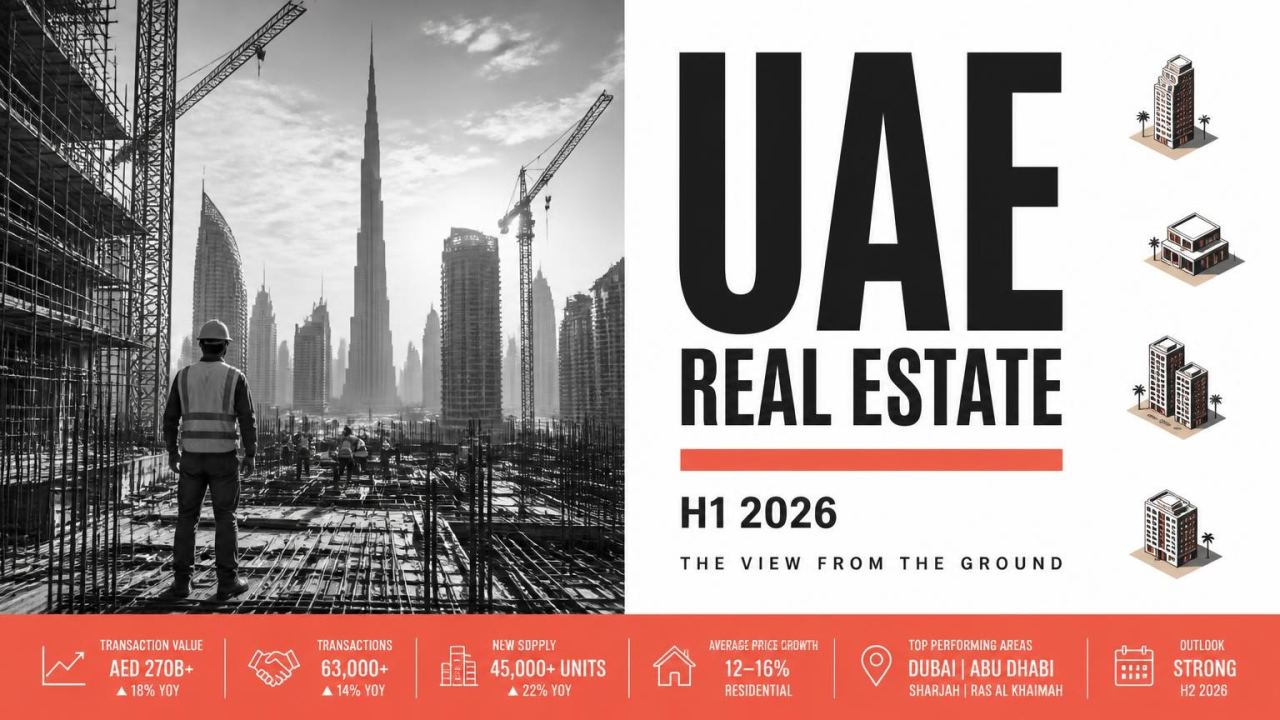
This is why you can see record transaction volumes, strong price action, and global attention, yet still hear the same refrain in institutional circles. The pipeline is thin, not because the market is small, but because the buyable format is limited.
What Needs To Happen, In Practical Terms
If the goal is institutional capital at scale, the UAE needs more of three things.
1 Single Owned Institutional Product, Deliberately Created
This sounds obvious, but it is rare. The market needs more assets designed to be held as one institutional line item, not sold unit by unit.
That means purpose-built rental residential. That means single ownership hospitality assets with professional operator contracts. That means commercial buildings with global occupier specifications, strong covenants, and credible tenant mix.
Institutional capital does not need every asset to be massive. It needs repeatable lot sizes, the kind that fit portfolio construction. Many allocators prefer a pipeline of mid-sized tickets that can be aggregated, rather than a single trophy deal that is difficult to exit.
2 A Financing Stack That Rewards Stabilization, Not Only Pre-Sales
The UAE has mastered the pre-sale machine, and it has done so with efficiency. But institutional stock often requires a different journey.
To create a stabilized income asset, capital must carry the project through completion, lease-up, or operational ramp. That requires financing frameworks that support stabilization, not only construction against retail sales.
If banks, credit platforms, and structured finance partners expand their comfort with stabilization-led development, developers gain incentive to hold, operate, and then sell whole assets into institutional hands.
3 Fewer Catch -22s In Land And Entitlements
Institutional capital hates ambiguity in development rights. If gross floor area, conversion costs, or final permitted envelope are unclear until after significant fees are paid, a deal becomes harder to underwrite.
The UAE moves fast, and that speed is an advantage. But institutional systems require synchronized clarity. Legal, regulatory, and transactional mechanics must line up, so capital can commit without feeling it is buying optionalities it did not price.
Why This Matters Beyond Real Estate
It is tempting to treat institutional capital as a badge. A headline. A signal that a market has arrived.
In the UAE, it is more practical than that.
Institutional capital brings longer duration money. It brings more stable asset management behaviour. It brings measurement, reporting, and standards that upgrade the ecosystem. It creates a secondary market for whole assets, which improves price discovery.
When institutional capital arrives at scale, a market becomes less dependent on momentum. It becomes more anchored to income, operations, and repeatable institutional logic.
That is what maturation looks like.
A Forward-Looking View From Abu Dhabi
The UAE does not need to convince the world it is serious. It needs to make institutional deployment easy to repeat.
The most promising signal is not a new announcement. It is the maturation of market infrastructure. More professional asset management. Clearer transactional rails. Deeper financing tools. More institutional formats built by design, not by exception.
And perhaps most importantly, a wider acceptance of a simple idea. Institutional capital is not attracted by speed alone. It is attracted by confidence that the system still holds when the cycle turns.
That is the institutional threshold. The UAE is already close. The next step is to make it repeatable.
First published on LinkedIn.