Markets and investing
Ras Al Khaimah and the Quiet Rewriting of Place
 Rosario Diaz Ausa
30 January 2026 · 6 min read
How an overlooked emirate is learning to behave like an economy
There are cities that announce themselves through spectacle and there are places that change through accumulation. Ras Al Khaimah belongs to the second category. Its transformation has not been shaped by a single architectural gesture or a dramatic skyline shift, but by the slow alignment of tourism, infrastructure, population, and capital. What is unfolding in the northernmost emirate of the UAE is not a rebrand. It is a recalibration of purpose.
For much of its recent history, Ras Al Khaimah was understood through landscape. Mountains, desert, and coastline framed it as a place of retreat rather than a place of momentum. It existed as a counterpoint to the hyper-urban energy of Dubai and the institutional weight of Abu Dhabi. That identity was accurate, but incomplete. It described what Ras Al Khaimah looked like, not what it was becoming.
Today, the emirate is beginning to function as something more complex than a destination. It is learning how to operate as a destination economy.
This distinction matters. A destination attracts visitors. A destination economy absorbs people, businesses, and time. It produces demand that extends beyond weekends and seasons. It generates housing needs, employment corridors, and long-term urban behavior. When this shift begins, real estate markets follow. Slowly at first, then visibly.
Tourism as Measurement Rather Than Metaphor
Tourism is often treated as an aspiration in emerging markets. In Ras Al Khaimah, it has become a measurable system.
In 2024, the emirate recorded approximately 1.3 million visitors, representing year-on-year growth. More revealing than the headline number was the change in how visitors arrived. Airport arrivals rose by close to thirty percent in a single year, signalling a transition from regional curiosity to international itinerary.
This shift is reflected in hotel performance. Occupancy levels reached their strongest first quarter on record. Average daily rates rose by more than eight percent. Revenue per available room followed the same trajectory. These indicators matter because they reveal pricing power. Demand is no longer sustained through discounting. It is being supported by willingness to pay.
Tourism has crossed an important threshold. It has moved from promise to performance.
Over time, this performance reshapes the real estate equation. Short-term accommodation expands. Serviced living gains relevance. Branded residences become legible to international buyers. What begins as a hospitality story gradually becomes a housing story.
The Meaning of Wynn
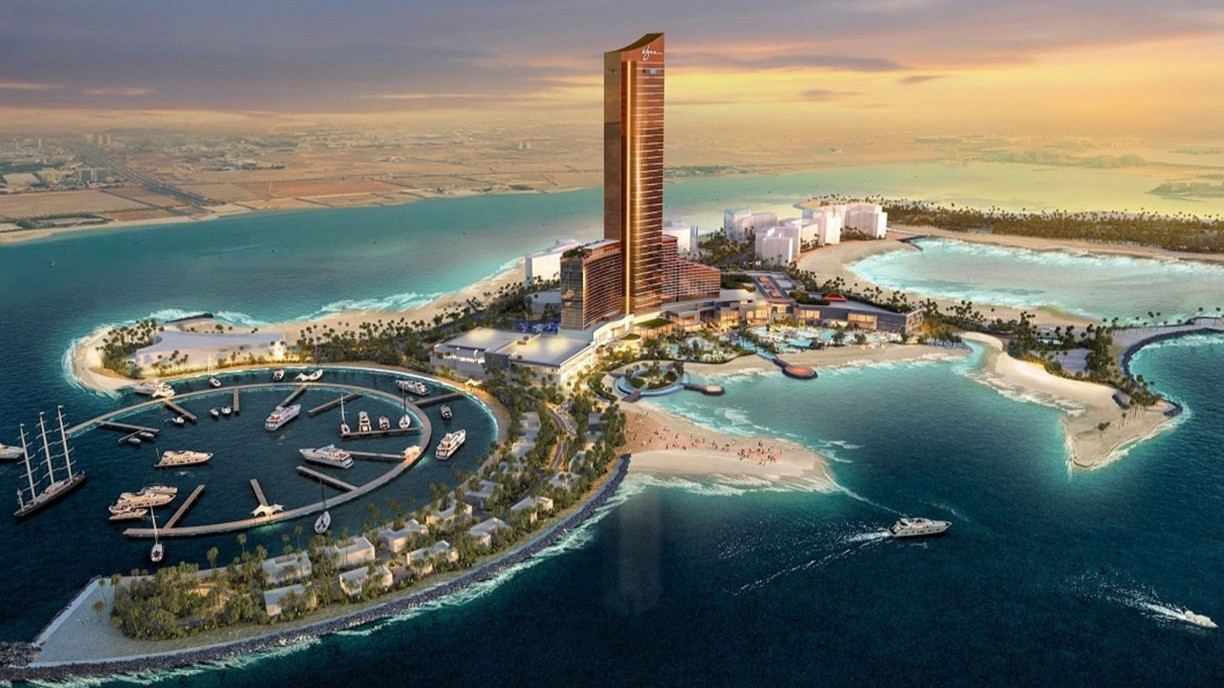
Much of the global attention on Ras Al Khaimah has focused on the Wynn Al Marjan Island project. Its scale is significant and its novelty in the region is undeniable. Yet its importance lies less in entertainment and more in institutional confidence.
When a global operator commits capital, design, and reputation to a market, it performs a form of public due diligence. It signals that regulatory structures are credible, that policy is stable, and that long-term demand is plausible. In this sense, Wynn functions less as a resort and more as a validator.
History offers parallels. Singapore’s Marina Bay Sands did not simply add rooms. It changed how the city was perceived by investors and developers. It created a gravitational center around which higher-quality urban and residential product clustered.
In Ras Al Khaimah, Wynn performs a similar role. It concentrates infrastructure investment. It organizes surrounding development. It anchors a new tourism corridor on Al Marjan Island. Most importantly, it reframes the emirate in the language of global destination capital.
This is not about gaming. It is about permission.
Economics Beneath the Coastline
Tourism alone does not create resilient real estate markets. What creates resilience is the interaction between tourism, employment, and population growth.
Ras Al Khaimah’s economy is unusually diversified for a destination-driven market. Manufacturing, wholesale and retail trade, construction, and real estate each contribute meaningfully to GDP. The construction sector has recorded double-digit growth, indicating that the physical city is expanding alongside its economic footprint.
Population growth reflects this evolution. From just over four hundred thousand residents today, Ras Al Khaimah is projected to approach six hundred thousand by the end of the decade. This is not a marginal increase for a market of its scale. It represents a shift in the size and structure of its urban base.
Business formation has accelerated as well. Thousands of new companies have registered in a single half year through the emirate’s free zone ecosystem. Each registration translates into employees, households, schools, and services. These are the ingredients of housing depth.
This is where the tourism narrative becomes an economic one. Visitors create motion. Residents create permanence. Real estate liquidity depends on the second.
Infrastructure as the Invisible Architect
Every market that transforms successfully does so through connectivity. Ras Al Khaimah’s strategy is infrastructure led in both physical and psychological terms.
Etihad Rail will integrate the emirate into the national transport grid. The airport is expanding capacity. A new commercial district is under development to accommodate offices, hotels, and urban residential living. Bridges and road links are reshaping internal geography.
Infrastructure does more than move people. It collapses distance. When travel time shortens, markets feel closer. When markets feel closer, capital becomes more mobile.
This is how secondary destinations become primary options. Not through marketing campaigns, but through friction reduction.
Ras Al Khaimah is being repositioned not as an escape from the UAE’s economic life, but as part of it.
When Residential Markets Begin to Speak
The clearest expression of transformation appears in housing.
In early 2025, average residential values rose sharply year on year. Apartment rents increased by more than twenty percent. Over one thousand off-plan transactions were recorded in a single quarter, representing billions in transaction value.
These numbers describe momentum, but they also describe depth. A market that was once thin is discovering layers of demand. End users, investors, and second-home buyers are participating simultaneously.
The character of supply is changing as well. Approximately one quarter of upcoming freehold stock is branded residential product, with an even higher concentration in waterfront areas such as Al Marjan Island. Brands matter in emerging markets because they create legibility. They translate unfamiliar geography into recognisable value. They widen the pool of potential buyers beyond those who know the market intimately.
Over time, this widens the resale universe. Liquidity follows recognition.
The Psychology of Timing
A natural question emerges whenever a market shows rapid growth. Has the opportunity passed.
This assumes that markets move in single waves. In reality, they move in phases. Announcement. Delivery. Utilisation. Maturity.
Ras Al Khaimah has passed the announcement phase. It is entering the delivery phase. The utilisation phase has not yet fully arrived.
Wynn is not operational. Rail connectivity is not yet live. The new commercial district is still under construction. Tourism targets have not been reached. Population growth is still unfolding.
The current moment sits between anticipation and evidence. Data is beginning to replace vision, but the full economic expression of that data has not yet materialised.
This is what transitional markets look like. They are no longer speculative, but not yet saturated.
A Place Becoming a System
What makes Ras Al Khaimah compelling is not speed but coherence. Luxury and upper-upscale hospitality is replacing mid-scale product. Employment zones are being planned alongside residential communities. Social infrastructure is becoming part of the growth conversation.
This is how a resort evolves into a city.
Cities are systems. They rely on schools, healthcare, transport, and jobs as much as they rely on hotels and views. When these systems begin to align, real estate moves from episodic demand to structural demand.
The emirate is no longer defined solely by escape. It is beginning to be defined by continuity.
Conclusion. The Quiet Arrival
Ras Al Khaimah is not attempting to compete with its neighbours. It is attempting to complete itself.
Tourism now has metrics. Infrastructure has timelines. Residential markets show liquidity. Economic growth is measurable. Population is rising. Brand participation is deepening.
The most important signal is not how much has already changed, but how much is still being built.
Recognition is the bridge between place and price. Ras Al Khaimah is crossing that bridge deliberately, without spectacle, and with increasing clarity of purpose.
Its story is not one of sudden arrival, but of quiet emergence. And in real estate, emergence is often where the most durable narratives begin.
First published on LinkedIn.